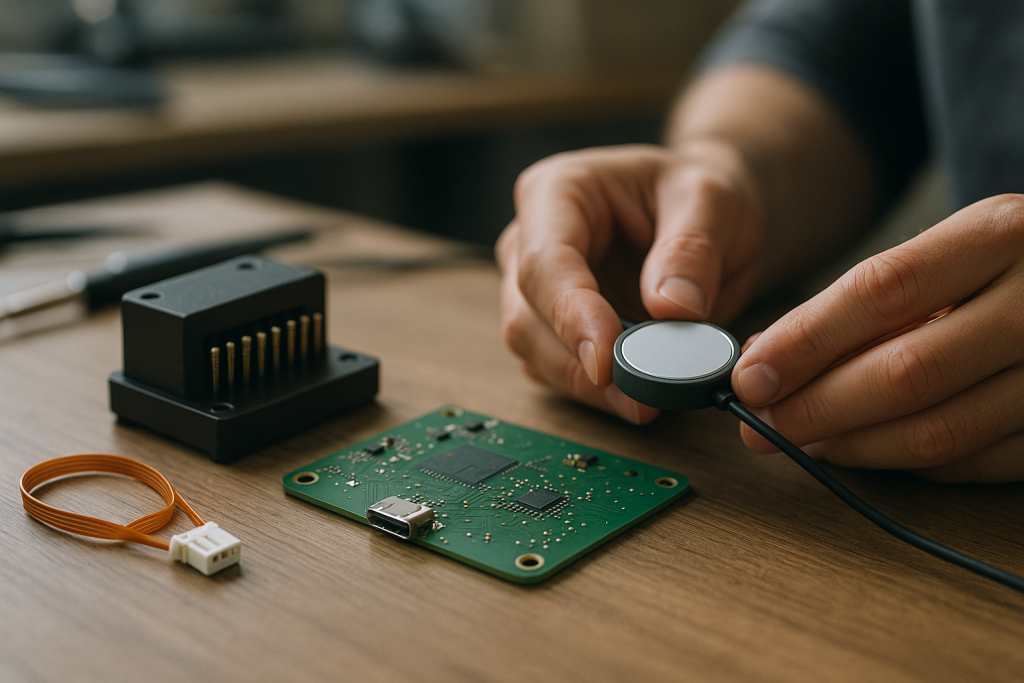
Which connector will get my product to market fastest while meeting durability and serviceability goals?
Connector selection electronics is about tradeoffs that affect schedule and the team roles you need. As a product leader, decide whether you want a user-facing port that suppliers recognize, an internal connector that keeps the enclosure sealed, or a contact interface that removes a user plug entirely. Your product manager defines the user experience and service model, and your manufacturing partner (or Shenzhen Futurezen Co. Ltd.) turns that brief into a parts list (bill of materials, BOM), enclosure drawings, prototypes, and validation testing.
How does connector selection electronics affect schedule and who owns which decisions?
Connector choices change three things that matter to timelines: how many assembly steps are required, whether the enclosure needs special tooling, and whether early prototypes must include connector alignment fixtures. If you prioritize speed to market, favor off the shelf user ports like USB-C for exposed connections, or standard internal connectors such as JST and board-to-board when the user never touches the port. Your product manager chooses the user-facing behavior, and your manufacturing partner implements the connector selection electronics tradeoffs, supplies candidate parts, and runs the prototype checks that confirm fit and function.
Which connector gets a product to market fastest?
Choose the option that minimizes custom enclosure work and extra assembly steps. Standard internal connectors often reduce enclosure iterations because they do not require user cutouts or seals. A common user-facing port like USB-C is widely understood by suppliers and speeds sourcing when users must connect cables. Options that require precise alignment, such as pogo pins or magnetic charging, usually need one more round of prototype housing checks, which can add time.
Which connector is most durable in daily use?
Durability depends on how the connector is mounted and supported, not only on the connector name. Pogo pins and magnetic charging remove repeated plug stress because the user does not insert a cable into a port, so they often show lower mechanical wear over time. A well supported USB-C port in the housing is also durable for frequent plugging. Internal connectors like JST or FPC are protected inside the case and see the least user wear. Your manufacturing partner will validate expected number of plug/unplug cycles and confirm the mechanical support during prototype testing.
Which connector is easiest to repair or service?
Repairability comes down to access and the planned service model. If you want field replaceable parts with minimal disassembly, choose an external port or a magnetic puck that can be swapped. If you accept opening the enclosure for service, internal connectors can be replaced by a technician. During design review we map your service expectations to connector selection electronics and choose connectors that match how you want devices serviced.
Which connector supports the power and data features my product needs?
Match the connector to the product function. USB-C supports higher charging current and standard data roles when you need them, while pogo pins and magnetic charging handle simple charging without a full data interface. Internal connectors like JST, FPC, and board-to-board are suitable when power and data needs are modest and benefit from a sealed case. We reference the official USB standard at usb.org for details on power and data capability, and your manufacturing partner will confirm compliance as part of prototype validation.
How should I use a simple decision framework to pick a connector?
Use this quick framework to make an early call, then let your manufacturing partner refine the parts list and housing drawings: 1) Decide whether the user needs a visible port or a sealed enclosure, 2) Choose a connector group that matches that user experience – USB-C for user ports, pogo pins or magnetic charging for sealed docking, JST/FPC/board-to-board for internal wiring, 3) Ask the partner to prototype the simplest option first and validate fit, mechanical support, and number of plug/unplug cycles. Connector selection electronics is best handled as a sequence of small decisions, not a single final choice at the end of design.
| Connector | Best for | Durability | Assembly complexity | Repairability | Charging current | Enclosure impact |
|---|---|---|---|---|---|---|
| USB-C | User-facing ports with data and power | High when supported in housing | Medium | Good, user-accessible | High | Requires cutout and strain relief |
| Pogo pins | Docking, sealed enclosures | High with proper contact design | Low to medium | Medium, often requires disassembly | Low to medium | Minimal openings, alignment needed |
| JST | Internal harness and battery connections | Medium | Low | Good for board removal | Low to medium | Fits inside, no user cutouts |
| FPC | Space constrained, flexible connections | Medium | Medium, careful handling | Lower, delicate to replace | Low to medium | Enables thin profiles |
| Board-to-board | Modular PCBs, compact stacks | High when latched | Medium | Lower, needs board access | Low to medium | Reduces external openings |
| Magnetic charging | Easy user docking, sealed cases | High, low mechanical wear | Low to medium | Good, often external puck replaces | Low to medium | Small cutout or flush surface |
| Waterproof connectors | Outdoor or washdown use | High | Medium to high | Good, but replacement needs sealing | Varies | Special gaskets or sealed ports |
How does the work play out in a real build?
We start by mapping the user flows, power needs, and enclosure constraints so connector selection electronics choices are tied to real use cases. Early prototypes use the simplest connector that meets the product goals so ergonomics and serviceability are validated quickly. Your manufacturing partner then iterates enclosure tooling, the parts list, and supplier selection, running prototype tests and mechanical checks. This sequence uncovers alignment and sealing issues early, reducing late changes and keeping your schedule predictable.
FAQ – common questions product leaders ask
Do I need USB-C if I only want charging?
Not always. USB-C is a good choice when you want common cables and higher charging current. If you only need simple charging without user plugs, pogo pins or magnetic charging keep the enclosure sealed and simplify the user experience. Your partner will present the right tradeoffs based on your product targets.
Are waterproof connectors always better for outdoor use?
Waterproof connectors help in wet environments, but they increase sealing and assembly steps. For many outdoor products a sealed enclosure with internal connectors gives the same real world durability while simplifying user maintenance. We evaluate both approaches against your durability goals.
How do you decide between JST and board-to-board connections?
JST is useful for simple wire harnesses and easy board removal, while board-to-board connectors make compact modular stacks with less internal wiring. We make the choice after matching layout to enclosure and service strategy.
Can you handle sourcing and testing the connectors for me?
Yes. Shenzhen Futurezen Co. Ltd. sources candidate parts, validates number of plug/unplug cycles, and tests mechanical fit and electrical function during prototypes so you do not need to manage individual suppliers. Start a conversation and we will prepare an options package tied to your parts list and launch plan.
Ready to decide? Talk to us about your parts list and prototype timeline
If you are choosing between USB-C, pogo pins, JST, FPC, board-to-board, or magnetic charging, share your product goals, prototype stage, part list (bill of materials, BOM), and service expectations. Our product team at Shenzhen Futurezen Co. Ltd. will review the options, build a short prototype plan, and show how connector selection electronics affects schedule and manufacturing. Contact us at /contact/ or learn how we work at /services/.