Introduction
Firmware Flashing in Electronics Manufacturing must be planned well before the first production run. Early choices about bootloaders, programming interfaces, secure key storage, and factory verification directly affect test fixtures, yield, field upgrades, and regulatory work. This guide helps hardware founders, product managers, and OEM buyers decide what to include in their BOM, fixtures, and factory flow.
Firmware Flashing in Electronics Manufacturing: bootloaders and programming access
Start with the software architecture. Decide whether you will use a primary bootloader, a secondary recovery bootloader, or a vendor-provided secure boot. The bootloader dictates supported programming methods, whether in-circuit programming, USB mass storage flashing, or over-the-air (OTA) setup during final test. If secure boot is required, map how secure keys will be provisioned in manufacturing and whether a secure element or TPM will be installed on the PCB.
Key planning questions
- Will the bootloader allow CRC or signature verification for images?
- Where will the programming entry points be located on the PCB?
- Will the device support field firmware updates or factory-only flashing?
Programming headers, test pads, and fixtures
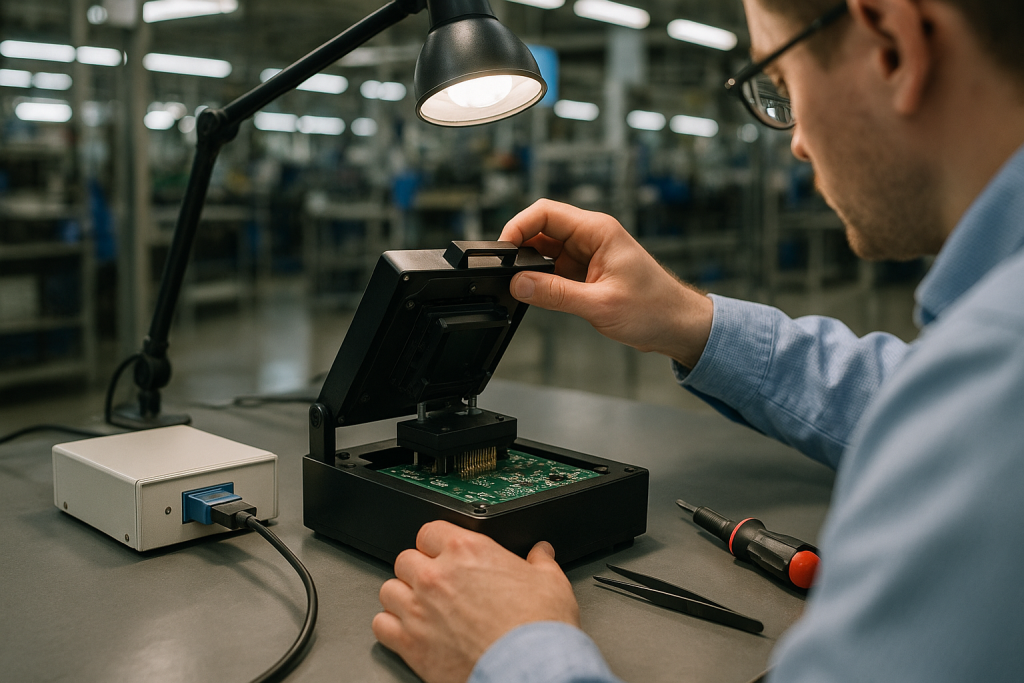
Design for access. Include a clearly labelled programming header or well spaced test pads for pogo-pin fixtures. If you use surface mount test pads, make their placement consistent across revisions so fixtures remain reusable. Include a mechanical keep-out for the fixture and a silkscreen identifier for JTAG, SWD, UART, or other interfaces.
- Choose between dedicated headers or micro pads based on volume and mechanical constraints.
- Document pinout, voltage levels, and protection diodes for the factory programming station.
- Plan fixture lifetime and spare parts for pogo pins and alignment tooling.
Serial numbers, calibration data, and unique identifiers
Decide when and how to burn serial numbers, calibration tables, MAC addresses, and IMEI numbers. Some teams write these identifiers to nonvolatile memory during initial flash, others program them into separate eeprom or secure elements. Define the authoritative source of truth for serials and ensure the factory system validates the programmed value against an MES or SPC feed.
For wireless devices, MAC and IMEI handling often requires vendor registration or reserved ranges. Verify requirements early and document the provisioning process in the manufacturing test plan.
Secure keys, provisioning, and compliance
Secure key handling is a risk area. If devices include private keys or device certificates, use hardware security modules or secure elements to reduce exposure. Do not program production private keys on unprotected mass flash memory when avoidable. Create a chain of custody for keys during delivery to the factory. For guidance on cryptographic key lifecycle management, consult authoritative sources such as NIST SP 800-57.
Version control, image signing, and rollback policy
Define one canonical firmware image per hardware revision and use semantic versioning in your build metadata. Sign images so the bootloader can verify authenticity. Establish a rollback policy and an A B partition strategy if you expect field updates. Maintain a build artifact repository that tracks which image was flashed into which serial number or hardware lot.
Fixtures, test flow, and failure logging
Design the factory test flow to include power, connectivity, functional tests, and a final verification stage. Fixtures should expose the same interfaces used for flashing, plus sensors or mechanical alignment features required for camera or display calibration. Implement clear failure logging and defect codes. Logs should be exportable and linkable to the device serial so teams can troubleshoot recurring failures quickly.
| Volume | Preferred method | Pros | Cons |
|---|---|---|---|
| Low 1-1000 units | Manual header or USB | Low NRE, flexible | Slower per unit |
| Medium 1k-50k | Pogo fixture with test station | Faster, repeatable | Fixture cost, maintenance |
| High 50k+ | In-line programming, ISP | High throughput | Higher setup cost |
Final verification and out of box testing
Final verification should confirm firmware version, serial or identifier, connectivity (WiFi, Bluetooth, cellular), and calibrated parameters for cameras, displays, or RF modules. Include a reproducible smoke test to verify device boot and a label printing stage for serial number or QR code. Keep a signed report per lot that records pass rates and any anomalies.
Practical checklist before pilot run
- Confirm bootloader and image signing scheme
- Finalize programming header or pad locations on the PCB
- Decide where serial, MAC, IMEI, and calibration data will live
- Plan secure key provisioning and key custody chain
- Design test fixtures and estimate fixture maintenance
- Implement failure logging and MES integration
FAQ
Q. When should we program MAC or IMEI?
A. Program MAC or IMEI during manufacturing final test, tied to the device serial. Confirm any registration steps required by standards authorities before committing ranges.
Q. How do we handle secure keys during flashing?
A. Use secure elements or HSM backed provisioning. Avoid inserting production keys into unprotected flash. Refer to NIST guidance and implement a documented chain of custody.
Q. Can OTA updates replace factory flashing?
A. OTA can handle future updates, but initial provisioning, calibration, and unique identifier programming usually happen in factory to ensure traceability and calibration accuracy.
Q. What is a good failure logging practice?
A. Log error codes with timestamps and serial numbers. Export logs daily to your MES and keep structured records for trend analysis.
Next steps and CTA
If you are preparing a pilot build or scaling production, discuss firmware flashing manufacturing plans with our team. Shenzhen Futurezen Co. Ltd. is a Shenzhen based product development and manufacturing partner and can help with bootloader choices, fixture design, secure provisioning, and factory integration. Contact us to review your product architecture, BOM, certification path, and manufacturing plan via our contact page.
For standards and registration tasks teams should verify current requirements with authoritative sources such as the NIST guidance linked above and the IEEE registry for MAC OUI allocations at https://regauth.standards.ieee.org/.