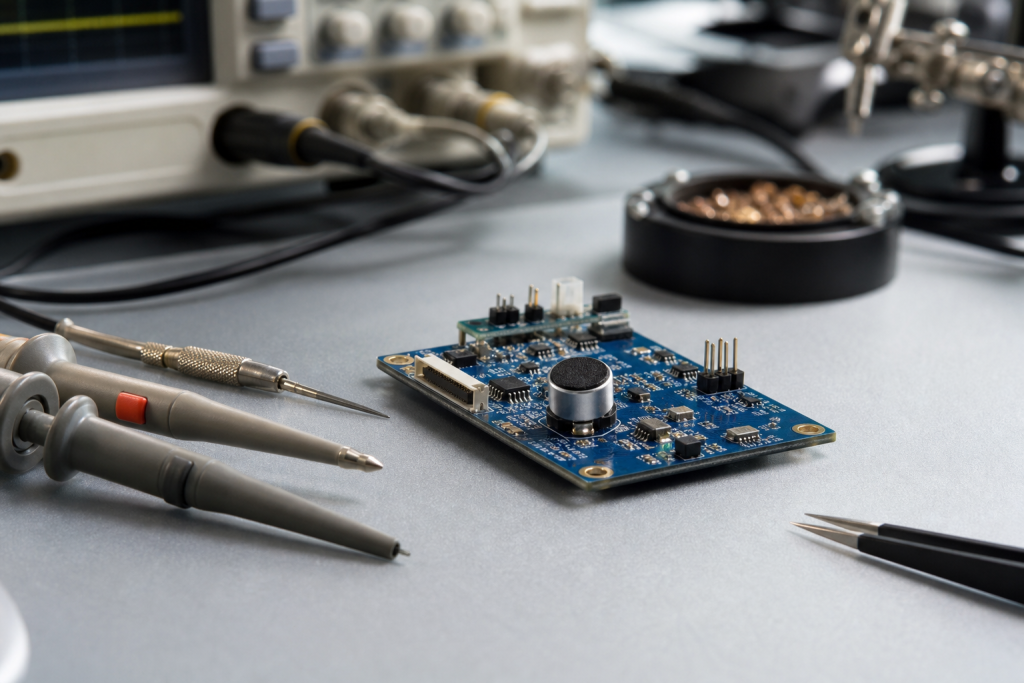
Choosing the right MEMS microphone is a small decision with big consequences. This article helps hardware founders, product managers, and OEM buyers decide between analog and digital MEMS, balance sensitivity and SNR, place acoustic ports correctly, design for enclosure leakage, pick reliable suppliers, and build production test fixtures that protect yield. Throughout, we highlight manufacturing tradeoffs and practical checks to run with your Shenzhen based product development and manufacturing partner, SZ Futurezen.
Analog vs Digital MEMS microphone tradeoffs
The first architecture choice is analog or digital MEMS microphone. Both use similar diaphragm technology, but their interfaces and system impacts differ.
- Analog MEMS microphone: Provides analog output similar to an electret mic. Requires an ADC or the SoC to include an analog front end. Pros include a simpler mic footprint and familiar analog gain staging. Cons include susceptibility to PCB noise, longer analog routing, and potential need for shielding and precise AGC.
- Digital MEMS microphone: Produces PDM or I2S output, offloading conversion to the microphone. Pros include better immunity to board level noise, simpler routing, and easier microphone array designs. Cons include higher interface complexity, clocking requirements, and sometimes higher power or latency depending on mode.
Choose digital when you need robust noise immunity or plan to do on board digital beamforming. Choose analog when PCB real estate, legacy ADCs, or simple low power audio paths are primary constraints. In every case validate clocking and EMI with a working prototype before freezing the BOM.
Sensitivity and signal to noise ratio, practical expectations
Sensitivity and SNR are the two acoustic specs you will see most often. Sensitivity tells you the output level for a known sound pressure. SNR indicates usable dynamic range. High sensitivity is valuable when the target is distant voice pickup, while high SNR matters if you need low noise for speech recognition or far field wake words.
- Check sensitivity in dBV or dB FS and SNR in dB. Compare on the same test conditions.
- Consider system noise floor. A high SNR mic can be negated by a noisy power rail or poor PCB layout.
- If you plan mic arrays, ensure matched gain and phase between channels, and source matched parts.
Acoustic port placement and enclosure leakage
Acoustic port placement is an often overlooked mechanical design decision. The port position, protective mesh, and leakage paths in the enclosure determine real world sensitivity and frequency response.
- Top port vs bottom port: Top port helps with direct exposure to sound but may be harder to route over an antenna or display. Bottom port can be easier to mask under grills but can couple to PCB cavity resonances.
- Enclosure leakage: Any leakage path between the port and internal cavities will alter low frequency response. Design gaskets, baffles, or acoustic tubes intentionally, do not rely on incidental seams.
- IP and filters: Dust filters and membranes change sensitivity and frequency response. Test with the actual filter you plan to use early in the prototype stage.
Supplier selection and BOM considerations
Pick suppliers not just for price but for lifecycle support, lead time, and quality. For connected devices, long term availability matters more than a small delta in unit cost.
- Request long term availability statements, recommended footprints, and sample lead times.
- Ask for device grades, shipping moisture sensitivity, and recommended reflow profiles.
- Validate part marking and batch traceability for future failure analysis.
- Verify current market pricing and lead times before committing to a production date, as these can change quickly.
Production test fixtures and manufacturing tradeoffs
Test time and fixture complexity directly affect cost. Plan tests that catch critical failures but fit into your per unit cost target.
- Electrical test: Validate power rails, digital I O, clocks, and basic functionality with a short functional test before acoustic testing.
- Acoustic test: Use a calibrated reference source in a small acoustic enclosure or automated chamber. Ensure repeatable mic to source alignment, and reduce ambient noise during test.
- Fixture design: Include a mechanical locator for the acoustic port, quick connect harnesses, and the ability to log measurements to your MES. Consider in line calibration checks rather than per unit full calibration if volume is high.
- Test time tradeoff: A 30 second acoustic functional test may be sufficient for most assemblies. Full frequency response calibration per unit increases cost and only makes sense for premium products.
| Feature | Analog MEMS microphone | Digital MEMS microphone |
|---|---|---|
| Noise immunity | Lower, needs careful routing | Higher, digital output is robust |
| System complexity | Requires ADC and analog gain | Requires clock and digital interface |
| Array and beamforming | Possible, needs matched analog channels | Preferred, easier synchronization |
| Cost drivers | Analog front end and shielding | Clock provisioning and interface logic |
Checklist for prototypes and production
- Prototype both analog and digital options where feasible to evaluate board noise and layout impact.
- Test acoustic port placement with the final enclosure and grills in a quiet room or acoustic chamber.
- Specify test time budget and design acoustic fixtures that align the port consistently.
- Ask suppliers for recommended PCB layout, reflow profile, and ESD handling procedures.
FAQ
Which is better for a battery powered product, analog or digital MEMS microphone?
Power depends on specific parts. Digital MEMS can be efficient, but clocks and interface power matter. Evaluate the full system power budget with representative silicon before final selection.
How close can I place the acoustic port to an antenna or speaker?
Keep the port away from strong local noise sources. If proximity to an antenna is required, test for RF coupling and consider shielding or alternate port placement. Validate with the final enclosure and antennas powered.
Do I need a full frequency calibration on each unit?
Not usually. Most connected devices use a functional acoustic test and spot calibration on random samples unless the product requires high fidelity audio. For voice AI applications, ensure consistent passband and SNR across units.
How should we pick a supplier?
Prioritize lifecycle support, sample availability, documentation, and local logistics. Ask suppliers for layout guidance, application notes, and reference designs. Verify current lead times and pricing before committing to production.
If you want help with architecture, BOM decisions, certification path, or production planning, discuss your project with SZ Futurezen. We are a Shenzhen based product development and manufacturing partner with experience integrating MEMS microphones into consumer and industrial connected devices. Contact us to review prototypes, design production fixtures, and build a reliable manufacturing plan.