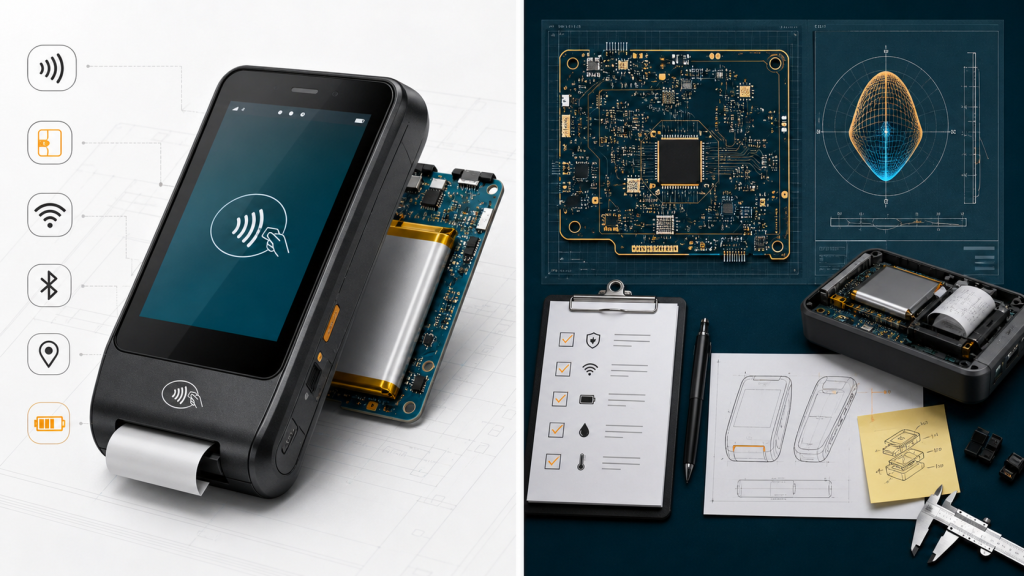
Custom POS Device Development: Hardware, Connectivity, Payment, and Certification Planning
Designing a retail-ready product starts with clear architecture decisions. This guide to custom POS device development walks hardware founders, product managers, and OEM/ODM buyers through processor selection, display and printer choices, NFC/payment modules, Wi‑Fi/Bluetooth/4G, battery and enclosure planning, certification paths, supplier coordination, pilot builds, and manufacturing risk mitigation.
Start with use cases and non-functional requirements
Before selecting components, define the core use cases: counter-top kiosk vs. handheld, tethered vs. mobile, receipt printing needs, simultaneous card/NFC transactions, expected daily usage, and environmental constraints. These shape your BOM, SOC, battery sizing, and certification scope during custom POS device development.
Processor and memory: balance cost, performance, and longevity
Choose a processor that supports your UI, crypto/payment stacks, peripheral drivers (printer, camera, NFC), and over‑the‑air updates. Consider:
- Application processors (ARM Cortex-A class) for rich GUIs, web-based apps, and camera work.
- Microcontrollers (Cortex-M) for simple terminals, low power, and deterministic I/O.
- Memory and storage: eMMC or eMMC‑like managed NAND for payment systems; ensure secure storage for keys and logs.
Plan lifecycle and secure boot support; vendors may change silicon roadmaps, so evaluate long-term availability and second-source options.
Display and input: size, brightness, and touch tech
Display choice affects enclosure, power, and software. Common decisions include:
- Capacitive touch with projected capacitive (PCAP) for best UX; consider glove use and water tolerance.
- Brightness and outdoor readability for mobile or outdoor POS.
- Secondary displays or customer-facing screens for receipts, QR codes, and promotions.
Receipt printing and paper handling
Decide between internal thermal printers for integrated receipt printing or external Bluetooth/USB printers. Key considerations: print width (58mm vs 80mm), paper roll diameter, cutter vs tear bar, print speed, and driver support in your OS stack.
NFC, EMV, and payment module integration
Payment acceptance requires careful integration of NFC/contactless modules, secure elements, and payment middleware. Architect options:
- Use certified payment modules (PN532-like or vendor modules) with clear security boundaries.
- Plan for a secure element (SE) or Host Card Emulation (HCE) depending on payment flows and certification needs.
- Keep payment processing and POS application separation to simplify certification scopes.
Avoid assuming a module choice guarantees certification; certification is a process involving software, hardware, and test evidence.
Connectivity: Wi‑Fi, Bluetooth, and cellular tradeoffs
Select radios based on deployment:
- Wi‑Fi for fast local networks, consider 2.4GHz vs 5GHz and antenna layout for throughput and range.
- Bluetooth (BLE/Classical) for peripheral pairing (scanners, printers) and low-power beacons.
- Cellular (4G/LTE) for mobile POS: choose module with carrier approvals, consider eUICC/sim provisioning needs.
Plan antenna placement early and allocate PCB keepout zones. RF tuning and certification testing can require board revisions if antennas are poorly designed.
Battery sizing and power management
For handheld POS, battery choice drives enclosure, weight, and runtime. Estimate duty cycle from peak processor load, radio use, printer bursts, and display on‑time. Include a battery management IC, fuel gauge, and safe charging design. Prototype with the actual battery chemistry and pack supplier to validate thermal and runtime behavior.
Enclosure, thermal, and serviceability
Design the enclosure for manufacturability (DFM), assembly, and field service. Consider:
- Materials, IP rating, and wear surfaces (fingerprints on screens, scanner windows).
- Access to batteries, SIM trays, and paper rolls for service.
- Thermal pathways for SOC heat; printers and cellular radios add heat and require airflow/heat sinking.
| Subsystem | Common Choice | Considerations |
|---|---|---|
| Processor | ARM A-series SoC | UI needs, crypto, camera, lifecycle |
| Display | 7″ PCAP / 5″ handheld | Brightness, touch, glove use |
| Printer | Thermal 58mm / 80mm | Paper path, cutter, driver support |
| NFC/Payment | Certified payment module + SE | Security boundary, certification scope |
| Connectivity | Wi‑Fi + BT ± 4G | Antenna layout, carrier approvals |
| Battery | Li‑ion pack w/ PMIC | Runtime, charging, thermal safety |
Certification path and planning (be cautious)
Certifications you may face include regional radio approvals (FCC, CE/RED), payment certifications (EMVCo, PCI PTS), and safety/EMC. Certification is multi-discipline: hardware, firmware, and test evidence. Map certification scopes early to your architecture and document interfaces clearly. Do not assume a module automatically removes all certification work; module-level approvals can reduce scope but often still require integration testing and labeling compliance.
Supplier coordination, NRE, and pilot builds
Coordinate early with suppliers: module vendors, PCB fabs, backlight/display vendors, battery suppliers, and payment middleware providers. Negotiate NRE for tooling, enclosure molds, and test jigs. Plan at least one pilot build for functional validation, EMI pre-scans, thermal checks, and operator feedback before full manufacturing. Use pilot builds to finalize the BOM, test plans, and packaging.
Manufacturing risk and mitigation
Common manufacturing risks include component lead-time shifts, RF rework after antenna issues, and failed EMC during final test. Mitigate risk by:
- Specifying alternate sources for long‑lead parts and critical components.
- Allocating engineering time and budget for iterative PCB revisions and EMI fixes.
- Using staged validation: bench validation → system integration → pilot → compliance testing.
FAQ: Practical questions on custom POS device development
How do I choose the right processor for my POS?
Base the choice on UI complexity, payment crypto needs, peripheral support (printer, camera, NFC), and expected software stack. Validate with a prototype and check vendor roadmaps for lifecycle risk.
Will using a certified payment module avoid certification?
Pre-certified modules can reduce scope, but integration and system-level testing are typically still required. Avoid assuming module certification equals final product approval.
What connectivity should a mobile POS include?
Mobile POS often uses Wi‑Fi + Bluetooth for peripherals and optional 4G/LTE for WAN. Antenna placement and carrier module approvals are critical; plan early and test radios in real deployments.
When should we run pilot builds?
Run pilot builds after firmware and hardware are functionally stable to validate assembly, thermal behavior, EMI risks, and field usability. Use pilots to refine the BOM and test procedures before ramp.
Next steps and how SZ Futurezen can help
SZ Futurezen is a Shenzhen‑based product development and manufacturing partner experienced with connected devices, POS, NFC, Bluetooth, camera, and cellular products. If you’re planning custom POS device development, discuss your product architecture, BOM strategy, certification path, or manufacturing plan with our engineering and sourcing teams. We can help scope pilot builds, supplier selection, and compliance roadmaps—while advising on risk reduction and DFM.
Contact CTA: Ready to convert requirements into an architecture and pilot plan? Contact SZ Futurezen to review your BOM, supplier strategy, and certification approach.