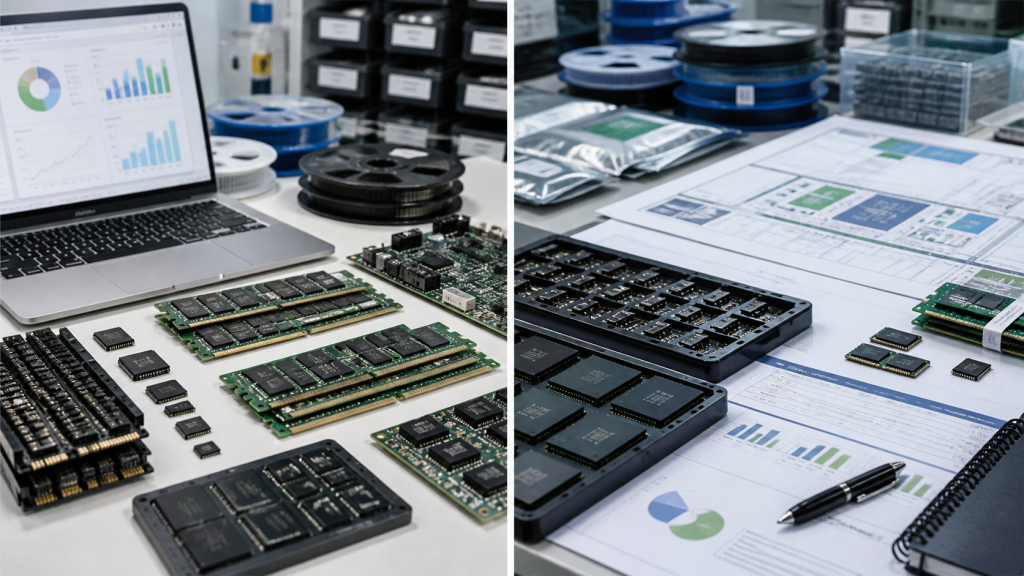
Introduction: RAM flash memory price trend and why it matters
Hardware teams building connected devices, AI hardware, POS terminals, NFC/Bluetooth products, cameras, displays, RF, or cellular devices need a practical view of the RAM flash memory price trend. Memory costs often form a significant share of BOM value and can change project economics, product features, and launch timing. This article explains current risk drivers, practical BOM and procurement strategies, and how to plan without relying on price guarantees. Teams should verify real-time market data before committing spend.
What drives the RAM flash memory price trend?
Memory pricing is driven by supply, demand, and production dynamics. Key drivers include:
- Foundry and wafer capacity allocation, which affects DRAM and NAND wafer starts.
- End-market demand shifts such as AI servers, smartphones, and automotive, which change consumption profiles rapidly.
- Inventory cycles at OEMs, distributors, and contract manufacturers—inventory build or correction can swing pricing.
- New process node transitions and factory ramp schedules for DRAM and NAND, which can temporarily tighten availability.
- Macro events and logistics constraints, which add timing and cost uncertainty.
None of these variables are static; teams must verify current vendor and distributor quotes before procurement.
DRAM versus NAND: different behaviors to plan for
DRAM (volatile memory) and NAND flash (non-volatile storage) follow related but distinct pricing cycles. Understanding the differences helps prioritize actions in BOM planning.
DRAM characteristics
- High sensitivity to server/AI and smartphone demand. Rapid swings when cloud/server orders increase.
- Typical lead times can shorten or lengthen quickly depending on capacity utilization.
- Substituting capacities or vendors can be limited by board/system-level constraints and certification.
NAND flash characteristics
- Wider range of form factors (eMMC, UFS, raw NAND, managed NAND) and price points, enabling more substitution options.
- Wear-leveling, endurance, and controllers matter—cost is not the only selection criterion.
- NAND pricing can be influenced by transitions to higher-density nodes where supply per wafer increases.
Decision framework: procurement strategies aligned to the RAM flash memory price trend
Use a simple decision table to choose a procurement posture based on product risk and timing.
| Component | Price volatility | Lead time risk | Suggested procurement strategy |
|---|---|---|---|
| DRAM | High | Medium to High | Agree allocations with multiple distributors, buy strategic buffer for production launch, and plan alternate SKUs if board space allows. |
| NAND flash (managed formats) | Medium | Medium | Prefer managed parts (eMMC/UFS) for easier substitution, validate controller firmware early, and stagger buys around production milestones. |
| SPI NOR / Boot flash | Lower | Low to Medium | Standard lead-time ordering with qualified alternates; keep critical-part safety stock for long-life products. |
Practical BOM planning steps given the RAM flash memory price trend
Adopt these concrete steps when designing BOM and sourcing memory:
- Specify at least two approved vendors for critical memory SKUs. Multi-sourcing reduces exposure to allocation risk.
- Use flexible footprints and layout margins when possible to support alternate package densities or vendors.
- Define acceptable performance/cost trade-offs early: e.g., whether to lock more DRAM for better performance vs. use less RAM to control BOM cost.
- Qualify managed NAND options (eMMC/UFS) early to avoid late firmware or controller issues during substitution.
- Include memory lead-time and price review gates in your stage-gate process—revisit quotes at design freeze and pre-production.
- Plan safety stock levels tied to product lifecycle and serviceability needs rather than fixed percentages.
Procurement timing and contract types
Several procurement approaches can reduce exposure to price swings, but none remove risk entirely:
- Short-term spot buys for small-volume, quick-turn runs — higher price risk but fast.
- Allocation agreements with distributors or direct agreements with memory vendors — can secure capacity but often require commitments.
- Consignment or vendor-managed inventory with EMS partners — reduces working capital but needs strong logistics controls.
Choosing a contract type depends on your volume forecast confidence, cash constraints, and risk tolerance. Always verify real-time market data and distributor lead times before signing.
Design and certification considerations tied to memory choices
Memory selections can affect power, thermal behavior, regulatory testing, and firmware development time. Early choices can avoid rework during compliance testing. Work with your Shenzhen-based product development and manufacturing partner to align BOM choices with certification plans and test schedules.
When to accept trade-offs versus when to prioritize stability
High-volume, long-life products should favor stability and supply agreements. Rapidly iterating prototypes or low-volume pilots can accept higher spot buying risk. Map each product SKU to a procurement posture and validate it at design freeze.
FAQ: RAM flash memory price trend
How should I monitor the RAM flash memory price trend?
Track distributor quotes, vendor allocation notices, and market reports; keep a rolling 3- to 6-month procurement forecast. Verify quotes before commitments because prices and lead times can change quickly.
Can I guarantee future memory pricing for a product launch?
No. Memory pricing is influenced by many external factors. You can reduce risk with multi-sourcing, allocations, and buffer stock, but avoid promising fixed future prices without contractual arrangements.
Is it better to design for maximum memory or plan lower capacity to save BOM cost?
That depends on product value and use cases. For premium or AI-enabled products, performance often requires more RAM. For cost-sensitive devices, validate minimum viable memory and ensure software optimization. Use a mix of SKUs to address both markets when feasible.
How does SZ Futurezen help with RAM flash memory price trend risk?
SZ Futurezen, a Shenzhen-based product development and manufacturing partner, helps teams map BOM risk, qualify alternate memory parts, and set procurement strategies aligned with production timelines and certification paths. We recommend verifying current market data before placing orders.
Next steps and a practical CTA
If you are deciding on product architecture, BOM composition, procurement timing, or certification path, discuss your specific memory risk and sourcing plan with SZ Futurezen. We can run a BOM risk review, suggest alternate part strategies, and help align your certification and manufacturing schedule to market realities. Contact us to plan concrete next steps and verify current supplier quotes before committing.
Note: This article is for planning and educational purposes. Memory market conditions change quickly; teams should verify current vendor, distributor, and market data before procurement or compliance decisions.