functional testing electronics manufacturing, Make the test call
Decision: Test every feature on every unit with a full functional test, or run a faster smoke check and accept some field risk. functional testing electronics manufacturing confirms the behavior you promised customers, or it does not. Pick full testing when you cannot accept customer-visible failures, or pick a lighter check when speed to shipment is the priority.
When should you choose functional testing electronics manufacturing?
Choose full testing when customer experience and support burden are the priorities. A full test exercises each customer-facing feature on every unit before it ships, catching issues that increase returns, support time, and reputation costs. Choose a smoke check when you are moving fast, expect small numbers of field fixes, and have the support processes in place to handle isolated problems.
What does a full test actually check?
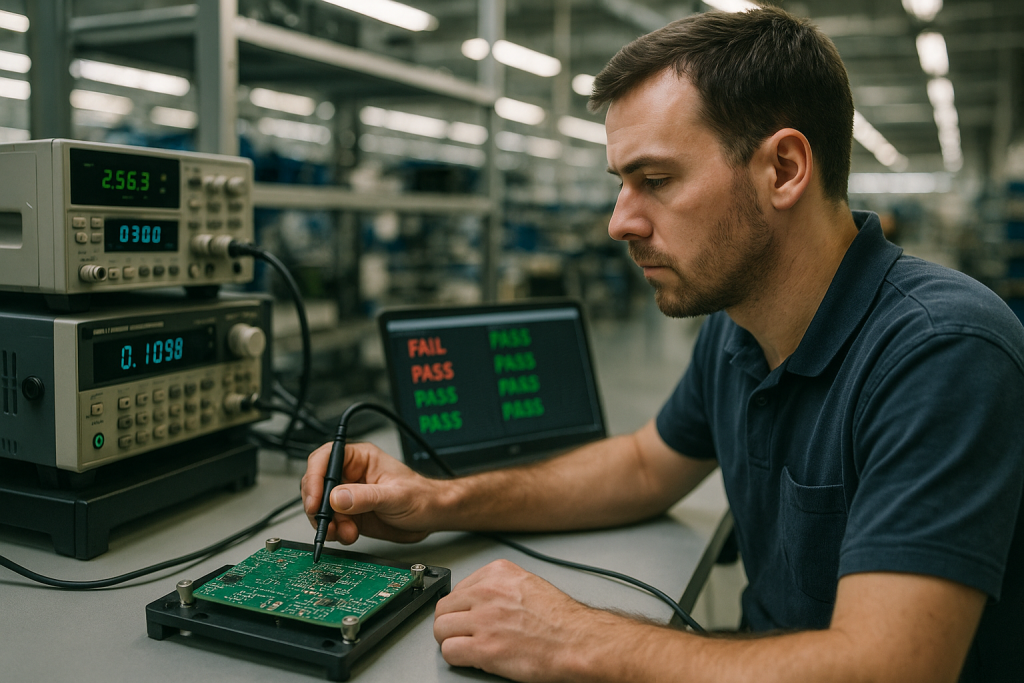
A full test verifies the functions that your customers use first. Typical checks include powering and booting, reading sensors and inputs, user interface elements such as buttons and LEDs, wireless pairing and connectivity, audio paths and microphone capture, camera capture where relevant, charging and battery behavior, and logging firmware version and serial numbers. We record a pass fail result for each item so you can trace any shipped unit back to its test record.
Which outcome matters to my product: fewer returns or faster shipments?
Frame the choice by outcome, not by factory work. Full testing protects your launch from customer returns, lengthy remote diagnosis, and brand impact when features fail in the field. A lighter check protects your launch date and lets you iterate in-market faster, at the expense of accepting a predictable number of in-field issues that require follow up.
| Option | When to choose it | What it protects you from | When it slows your launch |
|---|---|---|---|
| Smoke check | Tight deadlines, early pilots, fast iterations | Major build failures that prevent use | For feature failures that require customer returns or complex support |
| Bench functional test | Small batches, prototypes, or focused QA sampling | Most common feature-level faults, early regression catches | If every unit must be guaranteed to the customer, manual checks may be too slow |
| Automated fixture test | Production runs where every unit must be checked | Customer-visible failures, systemic firmware regressions | Initial setup can delay the first batch if you wait to build fixtures |
Does testing now make certification easier later?
Yes, in practical terms. Recording firmware versions, serial numbers, and test results creates a traceable snapshot of what shipped, which makes later certification confirmation or troubleshooting faster. We align wireless checks with guidance from standards bodies such as the Bluetooth SIG so test expectations map to certification steps. functional testing electronics manufacturing that includes those records reduces back-and-forth during formal testing.
How does Futurezen approach planning and sequencing tests?
We sequence checks to reduce rework and to protect throughput. For example, we validate power and boot first on early assemblies so a failed power regulator does not waste time in later feature tests. For devices with cameras we leave alignment-sensitive checks until final mechanical assembly, so we do not force multiple reworks if a camera needs adjustment. For wireless features we set connection duration based on certification needs and user experience; if certification requires sustained connections, we run a longer pairing test, otherwise a short pairing check confirms basic behavior while saving time on each unit.
At Futurezen we design functional testing electronics manufacturing plans around these tradeoffs, balancing test depth, throughput, and what you are protecting against. We document the plan and the expected outcomes so you can approve the scope without handling the technical design.
Our checklist for a first production run
- We draft a test plan that lists the must-pass customer features and the pass criteria for each item.
- We propose fixture and bench options, showing how each affects throughput and traceability.
- You review and approve the must-pass list, firmware baseline, and the fields to capture in pass fail logs.
- We run a pilot batch with the chosen test scope and share the pass fail reports and any recommended plan changes.
- We scale the chosen approach to the production cadence, keeping you updated on trend data and exceptions.
What does a pass fail log include and how does it help?
Pass fail logs should capture the unit serial number, firmware version, test timestamp, and a concise result code for any failed item. Those logs let your team see patterns across a batch, speed up warranty triage, and link shipped units to the exact checks that ran. We integrate logs into production records and deliver batch summaries on a cadence you choose.
FAQ
Do I need full testing for every unit?
It depends on the impact of a customer-facing failure. Full testing on every unit is the right call when a feature failure would cause costly returns, regulatory follow up, or heavy support work. Sampling or smoke checks can be acceptable when support processes are in place and you accept some field risk in exchange for faster shipments.
Should I invest in a custom test fixture or use bench tests?
Decide by outcome. Choose a fixture when you need consistent checks for every unit and traceable logs to reduce returns and support work. Use bench tests when the volume is low or the product is still changing, and you prefer faster setup. We will outline the trade off for your product, so you can approve the option that matches your launch priorities.
How do you handle wireless and camera checks?
We mirror expected user flows. For wireless, we capture pairing success and connection stability, and we align the test duration with certification requirements so the test reflects expected real world behavior. For cameras we confirm image capture and basic quality checks; if the camera needs optical tuning we sequence that check after final assembly to avoid rework.
If you want to discuss which testing approach fits your schedule and product risk, talk with our team at Futurezen. Contact us at /contact/ to share your prototype or manufacturing plan and we will propose the testing path that gets your product to customers reliably. For wireless guidance we reference standards such as the Bluetooth SIG Bluetooth resource and recommend formal lab verification where required.